

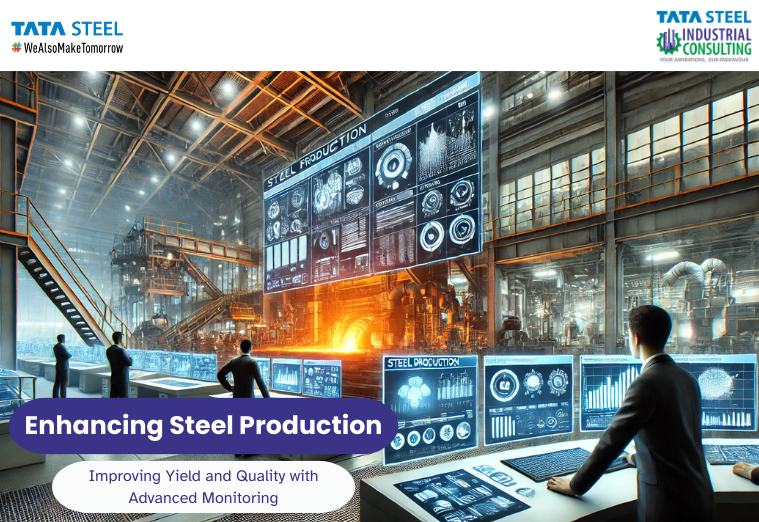
Steel manufacturing is a process that demands precision and constant refinement to meet growing industrial demands. Tata Steel Industrial Consulting (TSIC) stands at the forefront of this transformation, offering solutions that address complex challenges in steel production processes, Electric Arc Furnace (EAF) operations, defect reduction, yield enhancement, and sustainable waste utilization. Through advanced monitoring systems and data-driven insights, TSIC helps steel manufacturers increase efficiency, reduce costs, and achieve consistent product quality. This blog delves into the various strategies TSIC employs to optimize steel making, supported by real-world data and industry examples.
EAF Operations and Handling: Reducing Energy Consumption and Enhancing Efficiency
Electric Arc Furnaces are essential in the modern steel making process, yet they often face inefficiencies that increase energy consumption and production costs. TSIC's approach leverages advanced monitoring systems and real-time data analytics to optimize EAF operations, resulting in up to 15% energy savings. For example, a European steel producer reduced its annual energy costs by nearly $2 million after implementing TSIC's EAF optimization techniques. This advancement improves energy efficiency and supports environmental sustainability in steel manufacturing.
Mill-Scale and Sliver Reduction: Ensuring Product Quality and Minimizing Waste
Surface defects, like mill scale and slivers, can compromise the quality and durability of steel products. By using process optimization and intelligent monitoring systems, TSIC effectively minimizes these surface defects, improving surface quality by up to 20%. Reducing mill scale formation and slivers enhances product finish and minimize waste, translating to significant material savings and higher product standards in steel production methods.
Yield and Strike Rate Optimization: Maximizing Productivity and Resource Utilization
Improving yield in steel production processes is crucial for cost efficiency and material conservation. Even a minor increase in yield enhancement can lead to substantial savings. TSIC’s data-driven approach optimizes production parameters, helping steel making operations achieve higher strike rates and yields. For instance, a steel producer in Asia reported a 2.5% increase in yield and a 12% improvement in strike rate after adopting TSIC's recommendations, resulting in annual material cost savings of approximately $1.5 million.
Intelligent Quality Monitoring Systems: Real-Time Insights for Consistent Quality
Quality control is essential in steel manufacturing, especially for sectors like automotive and aerospace, where standards are stringent. Traditional sampling methods can miss inconsistencies, leading to product rework or waste. TSIC’s advanced monitoring systems provide real-time data on key quality indicators, enabling immediate adjustments to maintain consistency. This system has helped reduce scrap rates by up to 30%, saving a steel making mill over $500,000 in annual rework costs.
Waste Utilization: Sustainable Management with LD and LF Slag
The steel production processes generate significant slag waste, which, when unmanaged, poses environmental challenges. TSIC addresses this issue by repurposing Linz-Donawitz (LD) and Ladle Furnace (LF) slag for construction and other industries. This approach not only aligns with sustainability goals but also provides additional revenue. A steel producer reduced waste disposal costs by 25% and generated $300,000 in annual revenue from slag byproducts, underscoring the financial and environmental advantages of TSIC’s waste utilization solutions.
Ferroalloy Consumption Optimization: Precision in Alloy Use to Lower Costs
Ferroalloys are essential in steel manufacturing, but they are also costly. TSIC offers optimization solutions that allow steel production processes to precisely manage ferroalloy consumption, achieving the desired steel specifications with minimal waste. By implementing TSIC’s protocols, one steel manufacturer could reduce ferroalloy costs by 10%, resulting in $400,000 in annual savings. This precision reduces expenses without compromising the quality of the final product.
Optimal Chemistry for Desired Steel Specifications: Ensuring Compliance and Consistency
Meeting chemical composition standards is critical in producing high-quality steel. TSIC provides expertise in chemical process control, allowing steel making operations to achieve precise compositions. Through data-driven adjustments, TSIC ensures that production meets regulatory and industry standards, minimizing deviations and enhancing consistency. By reducing off-spec output by 15%, TSIC’s solutions decrease material waste, ensuring the final product aligns with the intended specifications.
Unique Differentiators of Tata Steel Industrial Consulting
TSIC's expertise and dedication to using data and analytics to improve steel production methods set it apart in steel business consulting. TSIC’s solutions are tailored to address each client's specific needs, providing actionable insights that lead to measurable improvements in efficiency, cost reduction, and product quality. This client-centric approach and advanced technology enable TSIC to offer a comprehensive solution suite that drives success across the steel production processes.
Summary Table: Key Areas of TSIC Expertise and Benefits
| TSIC Solution | Focus Area | Benefit | Quantifiable Outcome |
| EAF Operations and Handling | Electric Arc Furnace optimization | Reduced energy consumption | Up to 15% energy savings, $2 million in cost savings |
| Mill-Scale and Sliver Reduction | Surface quality improvement | Enhanced product finish, reduced waste | 20% improvement in surface quality |
| Yield and Strike Rate Optimization | Yield maximization | Higher productivity, cost savings | 2.5% yield increase, $1.5 million saved annually |
| Intelligent Quality Monitoring | Real-time quality control | Consistent product standards, reduced rework | 30% reduction in scrap rate, $500,000 annual savings |
| Waste Utilization (LD & LF Slag) | Sustainable waste management | Circular economy integration, additional revenue | 25% reduction in waste disposal costs, $300,000 in revenue |
| Ferroalloy Consumption Optimization | Alloy cost reduction | Lower raw material costs, precise alloy dosing | 10% reduction in ferroalloy costs, $400,000 saved |
| Optimal Chemistry for Steel Specs | Chemical process control | Achieve desired steel specs, minimize deviations | 15% reduction in off-spec production |
Conclusion
Through its innovative solutions and focus on data-backed strategies, Tata Steel Industrial Consulting is advancing the steel manufacturing industry by enhancing yield enhancement, quality, and sustainability. TSIC’s expertise in areas like EAF operations, advanced monitoring systems, and waste utilization empowers steelmakers to meet modern challenges and stay competitive. These data-driven solutions offer quantifiable benefits supporting profitability and environmental goals, making TSIC an invaluable partner in the evolving steel production processes.